
Search Thermo Fisher Scientific
 Element Search
 Structure Search
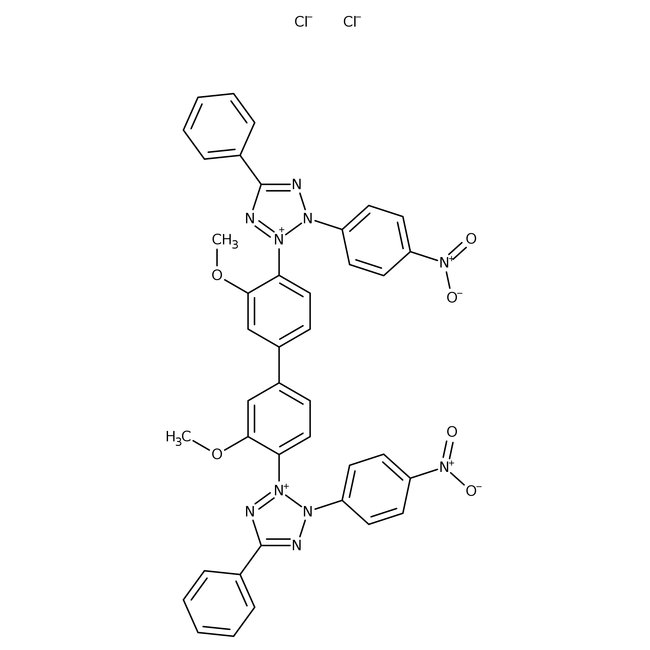

Thermo Scientific Chemicals
Nitro Blue Tetrazolium chloride, tech. 90%
CAS: 298-83-9 | C40H30Cl2N10O6 | 817.644 g/mol
| Catalog Number | Quantity |
|---|---|
| ALFB23792.02 | 0.5 g |
Catalog number ALFB23792.02
Price (MYR)
657.00
EA
Quantity:
0.5 g
Price (MYR)
657.00
EA
Specifications
Chemical Name or MaterialNitro Blue Tetrazolium chloride
CAS298-83-9
Health Hazard 1H302-H315-H319-H335
Health Hazard 2GHS H Statement
H302-H315-H319-H335
Harmful if swallowed.
Causes skin irritation.
Causes serious eye irritation.
May cause respiratory irritation.
H302-H315-H319-H335
Harmful if swallowed.
Causes skin irritation.
Causes serious eye irritation.
May cause respiratory irritation.
Health Hazard 3P261-P264b-P270-P271-P280-P301+P312-P302+P352-P304+P340-P305+P351+P338-P312-P330-P332+P313-P362-P501c
View more
Nitro Blue Tetrazolium chloride is used to confirm diagnosis of chronic granulomatous disease. It is a microscopic stain, which is used to detect dehydrogenases and alkaline phosphatase. It acts as an NADPH-diaphorase substrate that competitively inhibits nitric oxide synthase. Further, it is used in immunology for detection of alkaline phosphatase. In addition to this, it acts as an oxidant.
This Thermo Scientific Chemicals brand product was originally part of the Alfa Aesar product portfolio. Some documentation and label information may refer to the legacy brand. The original Alfa Aesar product / item code or SKU reference has not changed as a part of the brand transition to Thermo Scientific Chemicals.
Applications
Nitro Blue Tetrazolium chloride is used to confirm diagnosis of chronic granulomatous disease. It is a microscopic stain, which is used to detect dehydrogenases and alkaline phosphatase. It acts as an NADPH-diaphorase substrate that
Nitro Blue Tetrazolium chloride is used to confirm diagnosis of chronic granulomatous disease. It is a microscopic stain, which is used to detect dehydrogenases and alkaline phosphatase. It acts as an NADPH-diaphorase substrate that
RUO – Research Use Only
General References:
- Substrate for determination of various enzymes.
- Materska, M.; Konopacka, M.; Rogoliński, J.; Ślosarek, K. Antioxidant activity and protective effects against oxidative damage of human cells induced by X-radiation of phenolic glycosides isolated from pepper fruits Capsicum annuum L. Food Chem. 2015, 168, 546-553.
- Xiong, B.; Xu, R.; Zhou, R.; He, Y.; Yeung, E. S. Preventing UV induced cell damage by scavenging reactive oxygen species with enzyme-mimic Au-Pt nanocomposites. Talanta 2014, 120, 262-267.