
Search Thermo Fisher Scientific
 Element Search
 Structure Search
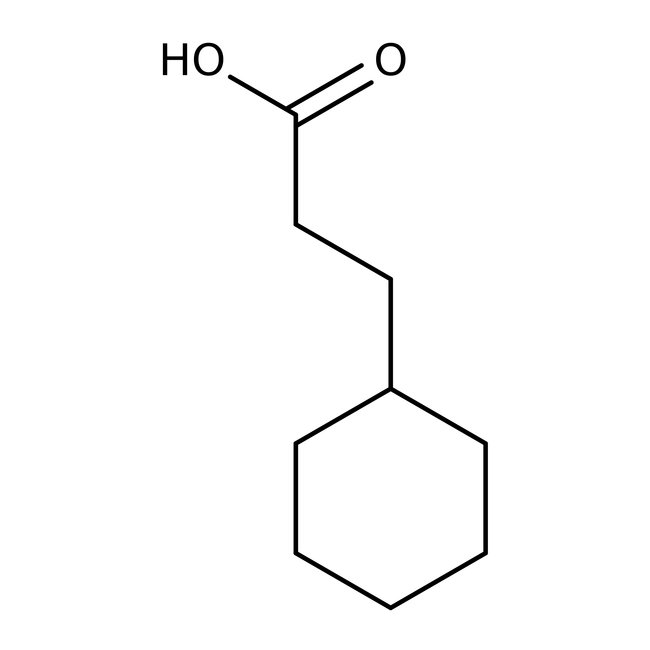

Thermo Scientific Chemicals
3-Cyclohexylpropionic acid, 98+%
CAS: 701-97-3 | C9H16O2 | 156.23 g/mol
| Catalog Number | Quantity |
|---|---|
| ALFB23613.18 | 50 g |
Catalog number ALFB23613.18
Price (MYR)
799.00
EA
Quantity:
50 g
Price (MYR)
799.00
EA
Specifications
Chemical Name or Material3-Cyclohexylpropionic acid
CAS701-97-3
Health Hazard 1H302-H315-H319
Health Hazard 2GHS H Statement
H301-H315-H319
Toxic if swallowed.
Causes skin irritation.
Causes serious eye irritation.
H301-H315-H319
Toxic if swallowed.
Causes skin irritation.
Causes serious eye irritation.
Health Hazard 3P264b-P270-P280-P301+P312-P302+P352-P305+P351+P338-P330-P332+P313-P362-P501c
View more
3-Cyclohexylpropionic acid can be used to produce 3-cyclohexyl-propionyl chloride. It is used as pharmaceutical intermediates in organic synthesis. It can also be used for the synthesis of pineapple esters.
This Thermo Scientific Chemicals brand product was originally part of the Alfa Aesar product portfolio. Some documentation and label information may refer to the legacy brand. The original Alfa Aesar product / item code or SKU reference has not changed as a part of the brand transition to Thermo Scientific Chemicals.
Applications
3-Cyclohexylpropionic acid can be used to produce 3-cyclohexyl-propionyl chloride. It is used as pharmaceutical intermediates in organic synthesis. It can also be used for the synthesis of pineapple esters.
Solubility
Soluble in water 10g/ L.
Notes
Store in cool, dry conditions in well sealed containers. Store away from oxidizing agents, bases.
3-Cyclohexylpropionic acid can be used to produce 3-cyclohexyl-propionyl chloride. It is used as pharmaceutical intermediates in organic synthesis. It can also be used for the synthesis of pineapple esters.
Solubility
Soluble in water 10g/ L.
Notes
Store in cool, dry conditions in well sealed containers. Store away from oxidizing agents, bases.
RUO – Research Use Only
General References:
- Leonard Spialter; Charles W. Harris. 2-Cyclohexylethyltricyclohexylsilan. Bildung von Cyclohexylethyllithium aus der Spaltung von Ethylether durch Cyclohexyllithium. J. Org. Chem. 1966, 31 (12), 4263-4264.
- M. Manning; W.A. Klis; M. Kruszynski; J.P. Przybylski; A. Olma; N.C. Wo; G.H. Pelton And W.H. Sawyer. Novel linear antagonists of the antidiuretic (V2) and vasopressor (V1) responses to vasopressin. International Journal of Peptide and Protein Research. 1988, 32 (6), 455-467.