
Search Thermo Fisher Scientific
 Element Search
 Structure Search
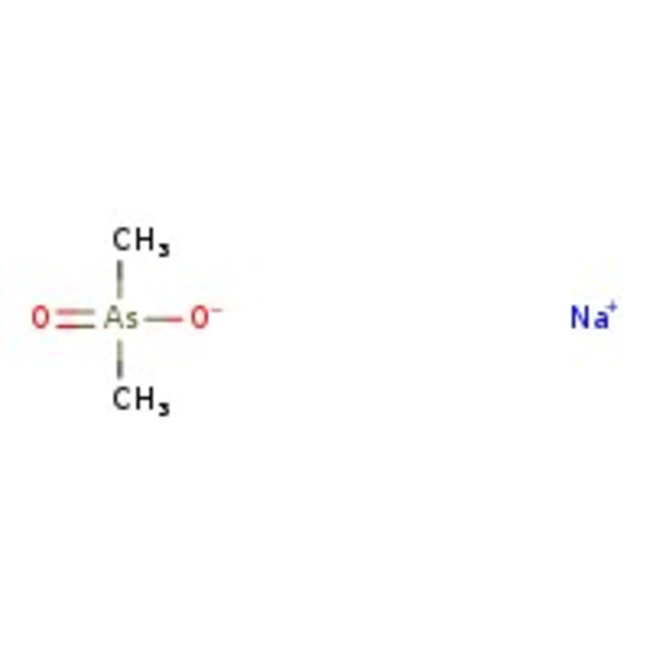

Thermo Scientific Chemicals
Cacodylic acid sodium salt trihydrate 98+%
CAS: 6131-99-3 | C2H12AsNaO5 | 214.024 g/mol
Have Questions?
Change view

Catalog number ALFA18139.22
Price (MYR)
1,775.00
EA
Quantity:
100 g
Price (MYR)
1,775.00
EA
Specifications
Chemical Name or MaterialCacodylic acid sodium salt trihydrate
CAS6131-99-3
Health Hazard 1H301+H331-H350-H373
Health Hazard 2GHS H Statement
H301-H331
Toxic if swallowed.
Toxic if inhaled.
H301-H331
Toxic if swallowed.
Toxic if inhaled.
Health Hazard 3P201-P202-P260-P264b-P270-P281-P301+P310-P308+P313-P330-P501c
View more
Cacodylic acid sodium salt is frequently used as a buffering agent during the preparation and fixation of biological samples for transmission in electron microscopy. It is also used as a buffer for formulating screens and for optimization.
This Thermo Scientific Chemicals brand product was originally part of the Alfa Aesar product portfolio. Some documentation and label information may refer to the legacy brand. The original Alfa Aesar product / item code or SKU reference has not changed as a part of the brand transition to Thermo Scientific Chemicals.
Applications
Cacodylic acid sodium salt is frequently used as a buffering agent during the preparation and fixation of biological samples for transmission in electron microscopy. It is also used as a buffer for formulating screens and for optimization.
Solubility
Soluble in water and alcohol. Insoluble in diethyl ether.
Notes
Store in cool place. Hygroscopic and moisture sensitive. Incompatible withstrong oxidizing agents and strong bases.
Cacodylic acid sodium salt is frequently used as a buffering agent during the preparation and fixation of biological samples for transmission in electron microscopy. It is also used as a buffer for formulating screens and for optimization.
Solubility
Soluble in water and alcohol. Insoluble in diethyl ether.
Notes
Store in cool place. Hygroscopic and moisture sensitive. Incompatible withstrong oxidizing agents and strong bases.
RUO – Research Use Only
General References:
- Sun, J.; Ma, L.; Yang, Z.; Lee, H.; Wang, L. Speciation and determination of bioavailable arsenic species in soil samples by one-step solvent extraction and high-performance liquid chromatography with inductively coupled plasma mass spectrometry. J. Sep. Sci. 2015, 38 (6), 943-950.
- Kaur, P.; Kiselar, J.; Yang, S.; Chance, M. R. Quantitative Protein Topography Analysis and High-Resolution Structure Prediction Using Hydroxyl Radical Labeling and Tandem-Ion Mass Spectrometry (MS) Mol Cell Proteomics. 2015, 14 (4), 1159-1168.